
Floyd County Court Records After Arrest
A Floyd County jail arrest creates a custody record first. That record may show the person's public roster name, age, sex, race, arrest date, custody status, charge text, warrant text, and bond display. The court record is different. It begins when the prosecutor or court files charging documents and the Clerk's system opens or updates the case. Floyd County Superior Court has felony jurisdiction, and the Floyd County District Attorney states that the office prosecutes misdemeanors and felonies in Floyd County.
That distinction prevents a common search error. The jail roster can say "Warrant," "Hold for Another County," "RE-BOOK," "Boarder," or "No Bond" before a final court charge appears. Use Floyd County jail inmate records for current custody and booking details. Use the court and Clerk sources for filed charges, case status, docket events, and dispositions. Booking photos are a separate records issue covered on the Floyd County jail mugshots page.
Find Floyd County Court Records
The official court path starts with the Floyd County Clerk of Court homepage, which links to case search and magistrate search. The research found the official case-search link, but command-line inspection returned a blocked response, so final copy should not invent form fields. Use the defendant's name, case number if known, arrest date, charge wording, and warrant number from the jail roster to narrow the court search.
- Start with the sheriff roster if the arrest is recent, and copy the exact charge, warrant, bond, status, and arrest-date text.
- Open the Clerk's official case-search portal or magistrate search link from the Clerk site.
- Search by defendant name or case number if known, then compare dates and charge text.
- For felony cases, check Superior Court and Clerk records because Superior Court has felony jurisdiction.
- If online search fails, contact the Clerk of Court or use the proper records-request channel for the record type.
The Floyd County Clerk homepage screenshot source shows the local court navigation used for case and magistrate search links.
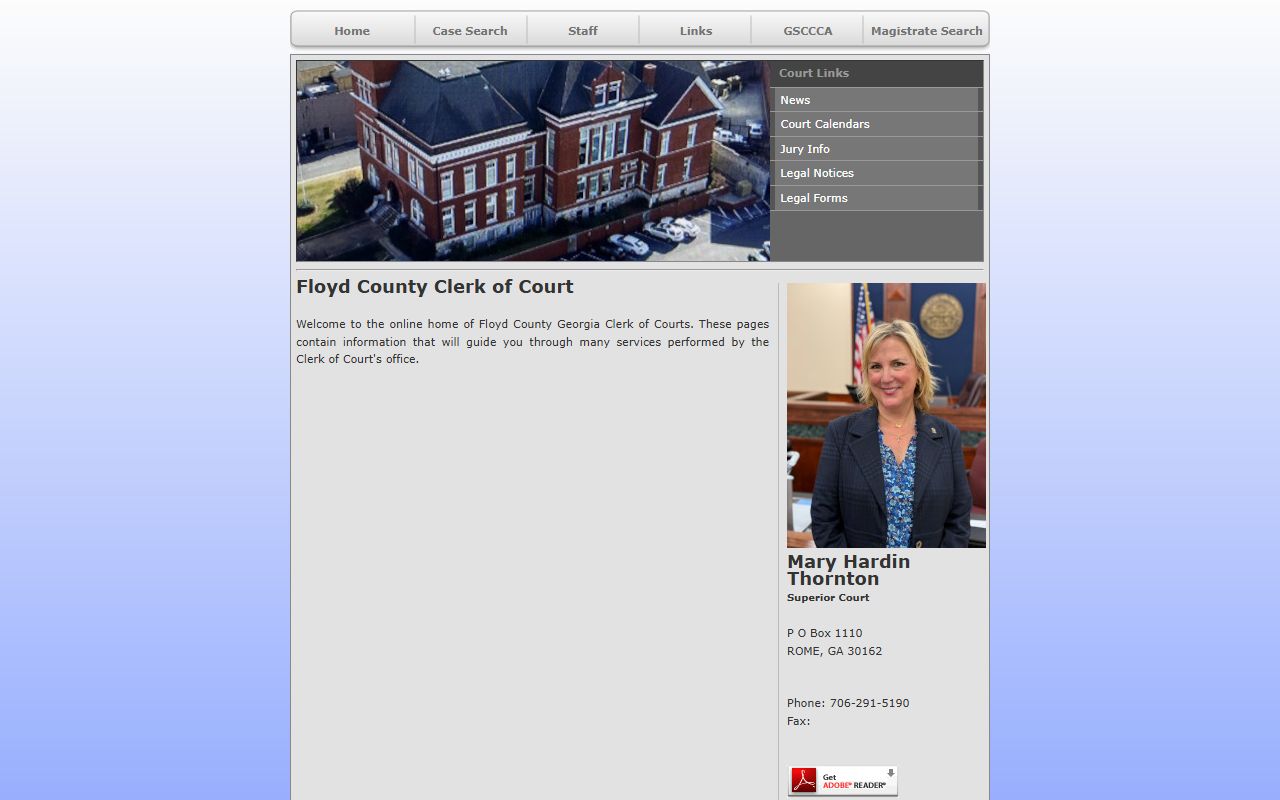
When a web search is blocked or a new case has not posted, the court office remains the better source for court records than the sheriff jail desk.
Charges After a Floyd County Arrest
Arrest charges can change. The District Attorney may file the same charge, amend it, reduce it, add a count, dismiss a count, or decline prosecution. A warrant entry on the roster may point to a court case, a municipal matter, or a bench warrant. A court record after a jail arrest should therefore be read by charging document and current status, not by the booking charge alone.
| Document | Common source | How it fits after arrest |
|---|---|---|
| Complaint | Law enforcement or prosecutor | Often begins a lower-level case or supports early court review after booking. |
| Accusation / information | Prosecutor | May formally charge a case without grand-jury indictment where Georgia procedure allows it. |
| Indictment | Grand jury | Common in serious felony matters and may replace or refine booking charge language. |
Floyd County Charge Status
Charge status tells a reader where the court record stands. It should not be confused with custody status. A person can be released from jail while charges remain pending, or remain in jail because of a hold even after one charge has a bond. Floyd County roster examples include no bond, property bond amounts, boarder status, holds, and awaiting transfer. Those custody clues help with court research but do not replace docket status.
| Status | What it usually means |
|---|---|
| Pending | The charge or case is still open and no final disposition has been entered. |
| Amended / reduced | The prosecutor or court changed the charge from the original booking or filing language. |
| Dismissed | The count or case was dropped by court order or prosecution action. |
| Nolle prosequi | The prosecutor chose not to proceed on that charge at that time. |
| Convicted | A plea, verdict, or judgment created a conviction record for that count. |
Bond After Floyd County Arrest
Bond is a release condition, not a court disposition. Floyd County's sheriff bonding page says the jail bonding lobby is open 24 hours a day except for a daily noon to 1:00 p.m. lunch closure. Cash or city bonds require the exact cash or money order amount plus a $20 cash service charge. Property bonds require qualifying Floyd County property, current taxes, the right deed type, all owners present when required, and identification.
| Bond type | Floyd County detail |
|---|---|
| Cash bond | Exact cash or money order plus $20 service charge at the bonding lobby. |
| Property bond | Floyd County property, warranty deed, current taxes, owner ID, and no mobile home, quitclaim deed, or security deed. |
| Surety bond | Sheriff lists approved bonding companies, including Bond James Bond, Corntassel Bonding, and Well-Done Bonding. |
| No-bond hold | A magistrate may deny bond; a hearing or attorney action may be needed. |
| Hold or detainer | Another county, probation matter, transfer, or ICE detainer may block release even when one charge has a bond. |
Warrants Leading to Arrest
The Floyd County Sheriff's Office Warrant Division maintains original warrants and keeps warrant information current in NCIC and GCIC. The public sheriff pages link to an active warrant portal through the same Zuercher public system used for current inmates and bond checks. Roster examples in the research include bench warrants, municipal warrants, felony warrants, probation warrants, and hold language.
For a warrant tied to a court record after a jail arrest, copy the warrant number, issuing court or agency, statute number, and charge description from the jail roster before searching court records. When the portal does not answer the question, the Warrant Division phone number in the research is 706-236-2466.
Charges vs Convictions
An arrest charge is an accusation or custody label. A conviction is a final case result from a plea or verdict. Floyd County court records after an arrest should be read with that difference in mind, especially when a person is checking employment, housing, licensing, immigration, or background-check consequences through a proper legal channel.
| Charge | Conviction | |
|---|---|---|
| Stage | Accusation, warrant, complaint, information, or indictment | Final judgment after plea or verdict |
| Proof | May begin with probable cause or prosecutor filing | Requires guilty plea, verdict, or other lawful judgment |
| Meaning | Does not prove guilt | Creates a criminal-history event unless later restricted or changed |
Restricted Court Records After Arrest
Georgia uses the term record restriction for many public-access limits, rather than treating every eligible outcome as an expungement. The GBI record restriction page identifies O.C.G.A. 35-3-37 as the state law source for eligible criminal-history restrictions. The practical question is whether a dismissed, not-prosecuted, acquitted, or otherwise eligible charge can be limited for non-criminal-justice purposes.
| Restricted / sealed access | Expunged language | |
|---|---|---|
| Public visibility | Public access may be limited if legal criteria are met. | Georgia sources often use restriction, so avoid assuming records are destroyed. |
| Who may still see it | Criminal justice agencies may retain or access restricted information under law. | Depends on the exact order and record type. |
| Where to start | GBI, prosecutor, court, or Clerk channels depending on the case outcome. | Use Georgia-specific record restriction rules, not generic web advice. |
Floyd County Records Requests
Some records after a jail arrest are not in the court portal. Booking records, jail logs, incident reports, and law-enforcement records usually follow the sheriff or county open-records path. Floyd County uses NextRequest, and the portal identifies County Clerk Lauren Chumbler as the official county records custodian for Georgia Open Records Act purposes. Court pleadings, docket entries, dispositions, and filings usually belong with the Clerk or court system instead.
The Floyd County NextRequest screenshot source shows the online public-records portal used for local requests.
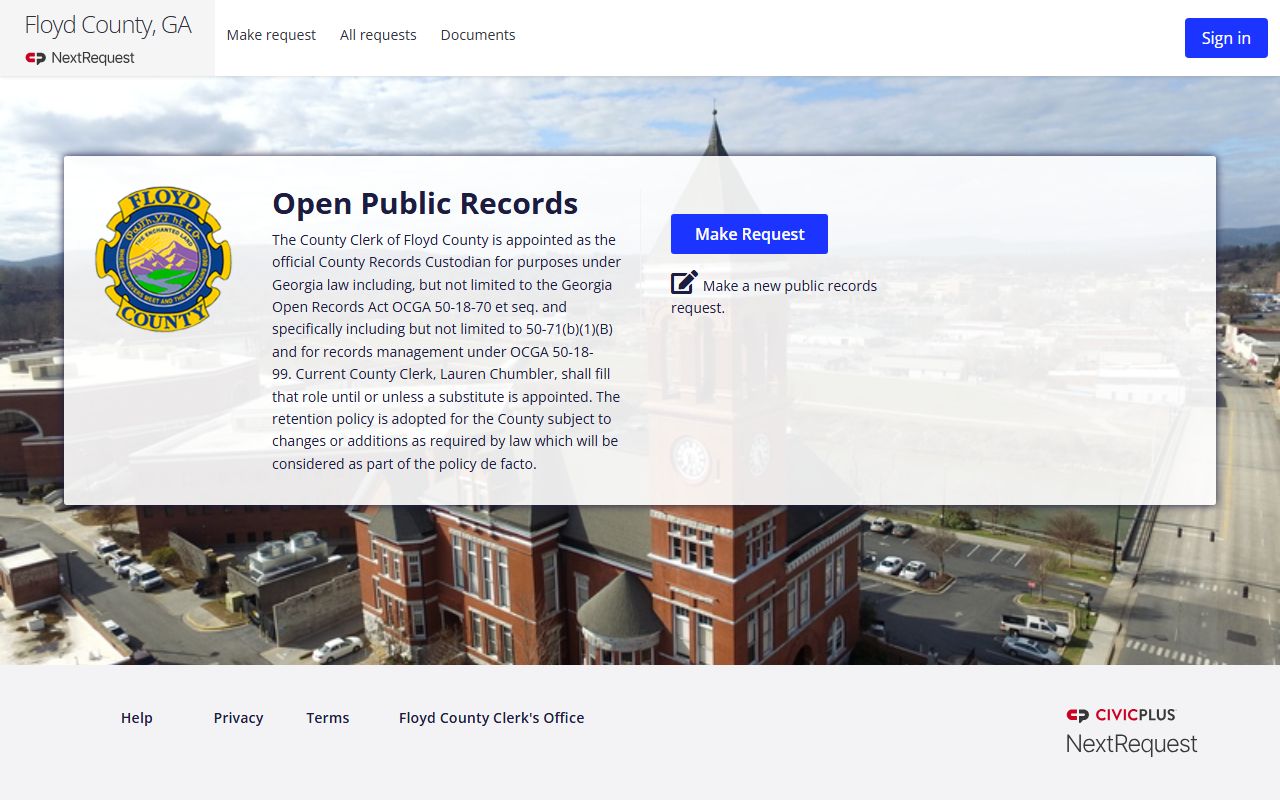
A strong request includes the full name, date of birth if known, incident or arrest date, agency, case number if known, and the exact record sought. Fees, redactions, exemptions, and custodian review may apply.
Background Check Limits
A casual court-record lookup is not the same as a legally compliant background check. The Fair Credit Reporting Act controls many employment, tenant, credit, and insurance screening uses. Public court records after a Floyd County jail arrest may be useful for personal review, case tracking, or locating an official office, but sensitive decisions require proper legal and screening procedures.
Important: Do not use this record reference for employment, credit, tenant screening, insurance, or any other FCRA-covered decision.
Restricted Floyd County Court Records
Not every arrest-related record is public in full. Juvenile matters, sealed cases, certain victim details, medical or mental-health information, home addresses, financial data, Social Security numbers, security records, and active-investigation material may be withheld or redacted. Bob Richards RYDC records are juvenile records, so adult roster and adult court-record assumptions should not be applied to youth custody.